

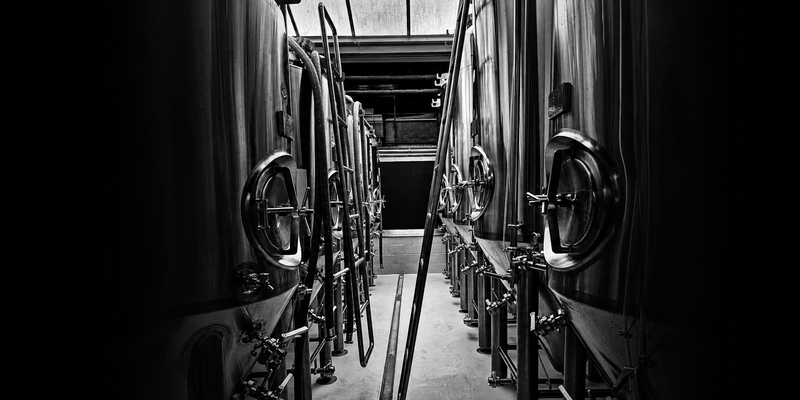
"Craft beer" is written on every label, including on beers that have nothing craft left about them. The term was born in the United States in the late 1970s to describe an independent brewer producing in small quantities, with no added flavourings. At Unseen Brewing Co., a Belgian brewery founded in Assesse that brews at CoHop (Etterbeek, Brussels), that definition isn't a marketing line: it's a set of specs we apply batch after batch, on beers like Clear Cut (6.9%, Citra, Simcoe, Nelson Sauvin) or the Hop Juice trilogy.
What is craft beer?
Craft beer, or artisanal beer, is beer brewed by an independent outfit, on a small scale, with raw ingredients — malt, hops, yeast, water — and no synthetic flavourings or additives. The term comes from the craft beer movement born in the United States in 1978, when a law signed by Jimmy Carter legalised homebrewing again, banned since Prohibition. Enthusiasts turned their hobby into a trade, drew on European — especially Belgian — traditions and made hoppier, more experimental versions of them. The movement crossed the Atlantic in the 2000s–2010s and took firm root in Belgium, a historic brewing nation where it shook up an industrial offer dominated by pils.
Visually, craft beer has no fixed codes: hazy or clear, dense or light head, IBU from 5 to 100. What sets it apart is the approach: rotating ranges, limited runs, collaborations, and a refusal of the frozen recipe that defines big brands. The flavour profile is generally bolder and varies more from batch to batch — a living beer varies, a standardised one doesn't.
Craft beer vs industrial beer: two philosophies
An industrial brewery aims for perfect repeatability: same taste, same head, across millions of hectolitres, filtered and pasteurised to keep the product stable over time. A craft brewery accepts the opposite — slight variation from batch to batch, in exchange for a livelier product and some risk-taking on the recipe. It's not a quality hierarchy, it's a choice of model: industrial brewing optimises consistency at scale, craft optimises aromatic intensity at small scale.
The line isn't purely about size either. Self-described craft breweries have grown without giving up their financial independence or their drive for constant innovation; conversely, industrial groups buy up craft brands to keep their visual codes without keeping their method. The West Coast IPA style is a good example: born in American craft brewing, it has been picked up — and sometimes watered down — by bigger players.
The criteria that define real craft beer
Three criteria keep coming up, wherever you are:
- Independence: the brewery isn't majority-owned by a large industrial drinks group.
- Limited scale: production that stays small-batch, far from the volumes of the giants — even if the exact threshold varies by country and is debated among professionals.
- Raw ingredients: malt, hops, yeast, water, with no synthetic flavourings or additives to mask a flaw.
In Belgium, these criteria sit on top of an already dense brewing tradition — Trappists, lambics, saisons — which sometimes blurs the line between "craft" and "traditional". A beer can be traditional without being craft (a recipe unchanged for a century, produced at scale) and, conversely, a craft beer can reinvent an old style with hops that didn't exist twenty years ago. That second path is Unseen's: international styles — NEIPA, DIPA, West Coast IPA — conceived in Assesse, brewed at CoHop (Etterbeek, Brussels) with traceable hop lots, like those from the collaboration with New Zealand grower Freestyle Hops on the Hop Juice trilogy.
Unfiltered, unpasteurised: the process that changes everything
Most craft beers are neither filtered nor pasteurised. Filtering means removing suspended particles — yeast, proteins — to get a clear beer that stays stable over time. Pasteurising means heating the beer to kill any remaining biological activity and secure its shelf life. Both processes stabilise the product, but they also flatten part of its aroma profile — a bit like drying a flower so it lasts longer: it survives, but it loses its scent.
An unfiltered craft beer keeps its yeast active and part of its dry hopping intact — that's hops added cold, after fermentation, for aroma rather than bitterness. The result: a more fragile beer, best enjoyed within months of canning, but also a more expressive one. It's a deliberate choice, not a technical compromise: freshness comes before shelf life.
Craft beer in Belgium, and at Unseen
In Belgium, the word "craft" covers a younger reality than the country's brewing tradition: the wave of independent microbreweries has mostly taken hold since the 2010s, alongside — not instead of — the historic Trappist and abbey breweries. Unseen is part of that recent wave, with a clear positioning: neither the accessible but undifferentiated traditional brewery, nor the cutting-edge but elitist experimental one. Every recipe — Clear Cut, Pachanero, the Hop Juice trilogy — is conceived in Assesse and brewed at CoHop, the brewing co-op in Etterbeek (Brussels), with traceable hops and malts and a documented process: fermentation temperature, pH, measured IBU, dry-hopping time.
This is a beer for those who want to taste a specific hop rather than a standardised bitterness — not watered down, not flattened by pasteurisation. Direct, hoppy, alive. That's Unseen.
See the full range — every product page lists the hops, ABV and style of each beer.
FAQ
What's the difference between craft beer and artisanal beer?
In practice, none: "craft" is the original English term, "artisanal" its equivalent. Both refer to an independent, small-scale brewery using raw ingredients. The legal meaning of "artisanal" does vary from country to country, whereas "craft" remains a common term with no single legal definition.
Why is craft beer almost never filtered or pasteurised?
Because those two processes stabilise beer for mass retail, but they reduce its aromatic intensity and kill its biological activity. Craft breweries prefer a living beer, to be drunk fresh, over a product calibrated to sit on a shelf for a year without changing.
Is craft beer always more bitter or more sour than regular beer?
No. Bitterness and acidity depend on the style, not on craft status. A craft lager can be softer than an industrial pils; a craft sour is sour by choice of fermentation. Craft is about the production method, not a set flavour profile.
Where can I buy Belgian craft beer like Unseen?
Directly at www.unseenbc.com, in 33 cl cans, with delivery in Belgium only (3 to 7 days). Unseen beers are also available from partner beer shops and in bars and restaurants — the list of stockists is kept up to date on the site.
To dig deeper into a specific style, read our article on Hazy Pale Ale and Belgian Beast.
Fancy a taste? Discover our beers of the moment or get our latest releases delivered to your door with the Big Box, our Belgian craft beer box.