

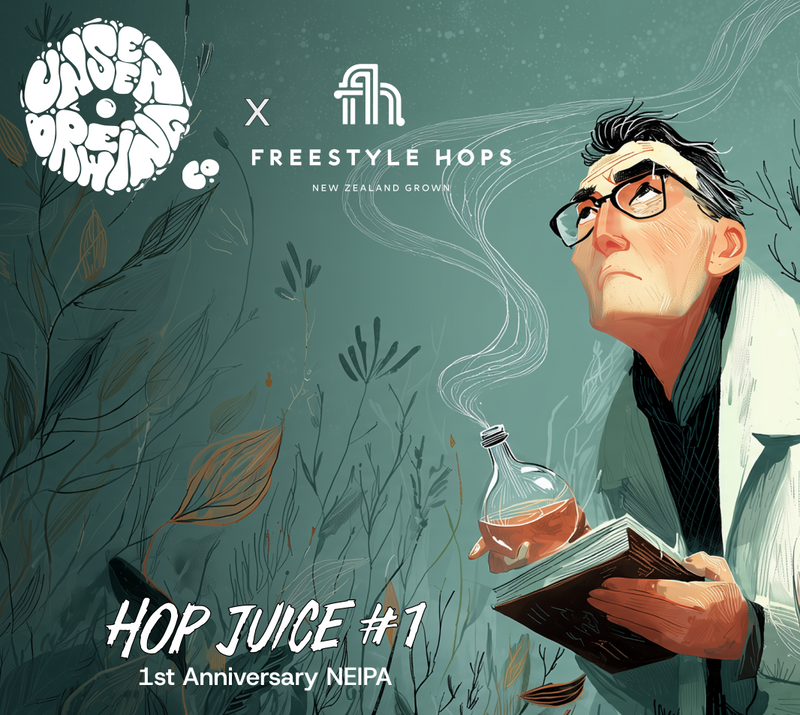
By Unseen Brewing Co. | Collaborations | Reading time: ~5 min
New Zealand hops have redrawn the aroma palette of modern beer: white grape, lime, tropical fruit — profiles you won't find anywhere else. For our first anniversary, we went straight to the source, to Freestyle Hops, an independent farm in the Nelson region, to brew Hop Juice #1, #2 and #3: a 6.5% NEIPA, an 8.3% DIPA and a 9.8% TIPA. And because a collab is more than a shared logo on the label, we also joined their brewer feedback programme.
Freestyle Hops: an independent farm in the Moutere Valley
Freestyle Hops was born in 2016, when Dave Dunbar and Mike Stone took over a hop farm in Sunrise Valley, Upper Moutere — at the top of New Zealand's South Island. The plot is anything but anonymous: Bruce Eggers grew hops there for more than fifty years, on clay gravels that the Nelson region has been working for a century and a half, ever since German immigrants planted the first bines next to the vines.
What sets Freestyle apart isn't nostalgia — it's method. Everything is grown, harvested, dried and processed on site, and the farm was the first to systematically link its field data (plot, harvest window, growing conditions of the year) to structured sensory feedback from the brewers who use its hops. The concrete result: the same Motueka picked early gives zesty, floral lime; picked late, it tips towards tropical.
If the names of their partners ring a bell — Hill Farmstead, Garage Project, Other Half — that's no surprise: Freestyle supplies some of the most cutting-edge breweries in the world. And a second farm, on the edge of Nelson Lakes National Park, is exploring a terroir where hops had never been grown before.
New Zealand vs American hops: two philosophies
American hops from the Yakima Valley defined the modern IPA: grapefruit, resin, pine — huge volumes and calibrated profiles, reproducible year after year. New Zealand hops play a different tune: a tiny fraction of world production, varieties rich in thiols (the aroma compounds you know from Sauvignon Blanc) and an expression that shifts with the plot and the week of harvest, like wine. No hierarchy, no rivalry: Citra, the American, actually steps in as backup in Hop Juice #1 and #3 — a familiar backbone for the Kiwi varieties to improvise on. As for Nelson Sauvin, you've already met it at ours: it signed the finish of Clear Cut, our West Coast IPA.
The hops in the three Hop Juices: from Wai-iti to Waimea
Hop Juice #1 (NEIPA, 6.5%) is built on Wai-iti, a variety low in alpha acids but loaded with aromatic oils: mandarin, lime, white peach. Nectaron pushes the tropical dial — pineapple, passion fruit — while Citra lays down the citrus base your taste buds already know.

Hop Juice #2 (DIPA, 8.3%) is our love letter to Nelson Sauvin, the hop that tastes like Sauvignon Blanc: white grape, gooseberry, a vinous edge. Alongside it, Manilita — an experimental selection from the Sunrise Valley farm's "thiol booster" trial plots: pink grapefruit zest, red berries, an almost candy-like sparkle. A variety so new it doesn't have a complete official spec sheet yet.

Hop Juice #3 (TIPA, 9.8%) calls on Waimea — candied mandarin, pine, a power built for dense beers — and the zesty lemon-lime of Motueka (the same hop behind our Mexican Lager La Chingona), with Citra once again in support.

Three beers, three expressions of the same terroir: delicate, vinous, massive.
Cold-Pressed Hop Juice: the process that gives the trilogy its name
Each beer contains the Cold-Pressed Hop Juice of its lead variety. The idea: freshly picked cones, never dried, cold-pressed right at the farm, then frozen. Think of the difference between fresh and dried basil: kilning — essential for storing hops — evaporates some of the most volatile compounds along the way, precisely the ones that smell of fresh fruit. The cold-pressed juice captures them before they escape. In the glass: Wai-iti (#1), Nelson Sauvin (#2) and Waimea (#3) in harvest form, as if the tank were parked in the middle of the hop garden. New Zealand harvests in March-April — our spring: these three beers can the freshness of a harvest from the other hemisphere, brewed at CoHop, in Brussels.
That's also where the partnership gets real. As members of Freestyle's brewer feedback programme, we document every batch — pellet aromas, behaviour in the dry hop, results in the finished beer — and send that data back to the farm, where it feeds into the choices for the next harvest. Taste, measure, pass it on: the loop is closed.
Hop Juice #1, #2, #3: the anniversary trilogy, Unseen style
A name is never random with us, and this one does double duty: "hop juice" is what the craft scene calls juicy IPAs — and it's also, literally, the Cold-Pressed Hop Juice flowing through each of the three recipes. Three "heavy hop juices" for a first anniversary, with a deliberate ABV progression: 6.5%, 8.3%, 9.8%. Same aromatic direction, rising intensity — three floors of the same house.
#1, the NEIPA, is the way in: mandarin-pineapple nose, supple body carried by oats and wheat, juicy finish. #2, the DIPA, gets denser: white grape and pink grapefruit on the nose, a fuller palate, that vinous tension only Nelson Sauvin delivers. #3, the TIPA, owns its 9.8%: candied mandarin and resin, massive body but a surprisingly dry finish — the alcohol carries the aromas, it doesn't crush them. All three in 33cl cans, brewed at CoHop (Brussels), dreamed up in Assesse.
It's a trilogy for curious drinkers who want to taste what terroir changes in a beer — not an anniversary patting itself on the back. Juicy, progressive, unapologetic. That's Unseen.
FAQ
What's the difference between a NEIPA, a DIPA and a TIPA?
All three belong to the family of juicy, hazy IPAs. A NEIPA sits around 6–7% ABV. A DIPA (Double IPA) climbs to 8–9%, with more malt and more hops. A TIPA (Triple IPA) goes above 9%: more of everything, and balance becomes the real challenge. Hop Juice #1, #2 and #3 follow exactly that scale: 6.5%, 8.3%, 9.8%.
Why New Zealand hops rather than American ones?
Not "rather than" — "together with": Citra features in two of the three recipes. But New Zealand varieties offer profiles you can't find anywhere else: expressive thiols, white grape, lime, exotic fruit, and an expression of terroir that shifts with the plot and the harvest window. Freestyle Hops pushes that signature further than anyone — and that's what we wanted in our anniversary beers.
Is a 9.8% TIPA necessarily heavy and sweet?
No. The high alcohol comes from fermented sugars, not residual syrup. Hop Juice #3 finishes dry: the body is dense, but nothing's sticky. Serve it between 8 and 10°C in a tulip glass, ideally with a friend — 33cl of TIPA is made for sharing.
Where can I buy Hop Juice #1, #2 and #3?
All three beers are available on www.unseenbc.com and at our partner bars and beer shops in Belgium. They're anniversary editions brewed in limited quantities — once they're gone, you'll have to wait for what comes next. Follow #unseenbc for stockists and releases.