

By Unseen Brewing Co. | New Beers | Read: ~5 min
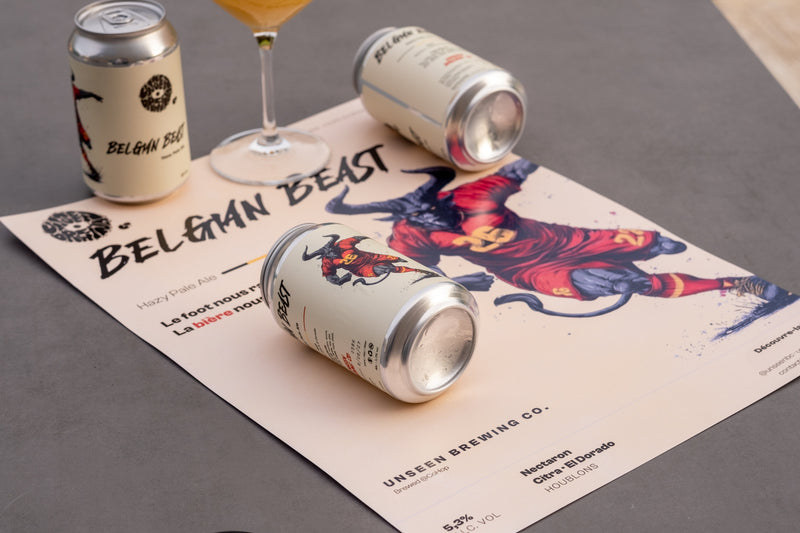
Hazy Pale Ale redefines what accessible means in craft beer: no less hops, no less aroma — just less alcohol, so the hops remain at the forefront without the ABV muddling the tasting experience. That's Belgian Beast: 5.3%, Nectaron leading the charge, El Dorado and Citra as escorts, brewed at CoHop in Brussels. And brewed for a specific moment: the 2026 World Cup, in support of the Red Devils.
What is a Hazy Pale Ale?
Born in the craft scene of Vermont and Massachusetts in the early 2000s, Hazy Pale Ale is now one of the most brewed styles worldwide. It shares the DNA of New England IPA — massive late-boil hopping, low attenuating yeast, use of oats and wheat for texture — but drops to 4.5–5.5% alcohol.
Visually, it appears hazy, cloudy, sometimes almost milky. This turbidity is not a defect: it comes from grain proteins (barley, oats, wheat) and yeasts left in suspension — exactly the same elements that give this creamy body and velvety texture in the mouth.
General taste profile: soft attack, moderate and clean bitterness, juicy and aromatic finish. The hops express their most fragile oils — terpenes, thiols — because they are not degraded by prolonged boiling. The result is a beer you drink with your nose as much as with your mouth.
Hazy Pale Ale vs. American Pale Ale: two visions of hops
The American Pale Ale defined 1990s–2000s craft beer: clear, filtered, with a distinct bitterness (30–45 IBU) and a citrus-pine profile achieved through moderate dry hopping. The yeast works cleanly, the hops provide the structure. It's calibrated, reproducible, honest.
The Hazy Pale Ale starts from a different place: hazy by design, massive hopping concentrated at low temperatures, gentle bitterness despite the quantities of hops used. Not an opposition — two different ways to make the same plants speak. Belgian Beast is resolutely in the hazy camp: Nectaron does not tolerate its fruit being hidden behind pine resin.
The hops of Belgian Beast: Nectaron, El Dorado, Citra
Nectaron is the heart of Belgian Beast. Developed by Plant & Food Research in New Zealand and commercialized in 2020, it is a triploid hop saturated with aromatic oils — 3.5 to 5.5 mL/100g, among the most expressive on the market. Its profile: intense pineapple, passion fruit, white peach, pink grapefruit in the background. It expresses itself especially in dry hop, where low temperatures preserve its most volatile terpenes. You've already encountered it at Unseen in Hop Juice #1, our anniversary NEIPA, in an even denser register.
El Dorado is the American counterpart. Grown in the Yakima Valley (Washington), it displays a tropical-candy profile with no direct equivalent: watermelon, ripe pear, mango, with a hint of candy. Its high alpha (13–17%) also makes it a structural hop, but here its aromatic expression in late addition is what matters — a sweet-exotic layer that rounds out the Nectaron profile without overpowering it.
Citra provides the backbone. Its citrus notes — lemon, orange, lime — anchor the other two in something recognizable, almost familiar. Without it, the profile might drift towards abstract tropical. With it, Belgian Beast maintains a clear direction. Nectaron brings power, El Dorado brings roundness, Citra brings clarity.
Dry hopping a Hazy Pale Ale
Dry hopping refers to adding hops cold to the fermentation or maturation tank — at temperatures where the essential oils do not evaporate but infuse directly into the beer. Terpenes, esters, and thiols pass into the liquid without being degraded by heat. Think of the difference between lemon squeezed into cold water and boiling water: in the first, you retain all the aromas.
For a Hazy Pale like Belgian Beast, hopping is concentrated at the end of brewing (whirlpool, late additions) and in post-fermentation dry hop. Oats and wheat also play their role: their proteins cling to the aromatic compounds of the hops, prolonging the perception on the palate. It is the combination of intensive dry hopping and a soft grain bill — barley, oats, wheat — that generates the characteristic creamy texture of the style. The turbidity is visible proof that nothing has been filtered.
Belgian Beast: Hazy Pale Ale by Unseen
The name does double duty. "Belgian": because this beer was born from a specific occasion — the 2026 World Cup, with the Red Devils competing. A 5.3% beer to watch a match to the end, not a tasting beer that presents itself as an object of contemplation. "Beast": because the power here is not in the alcohol. The beast is Nectaron.
5.3%: a deliberate choice. Low enough to last through extra time, high enough for the beer to carry its grain bill and hopping without seeming diluted. The oats provide the velvety body; the wheat, the lightness of the foam.
On the nose: fresh pineapple and watermelon, ripe pear in the background — Nectaron and El Dorado intertwine from the first inhale. On the palate: soft and creamy attack, grapefruit and passion fruit in the middle, clean and juicy finish, light bitterness that doesn't linger.
This is a beer for the curious who want all the aroma of an IPA — not the alcohol that excuses or drowns it out. Hazy, juicy, Belgian to the core. That's Unseen.

Belgian Beast — 1st Anniversary NEIPA × Freestyle Hops | Unseen Brewing Co.
FAQ
What's the difference between a Hazy Pale Ale and a NEIPA?
NEIPA and Hazy Pale Ale share the same philosophy — hazy, massive hopping, soft bitterness — but differ in alcohol content. A NEIPA is usually between 6 and 8% ABV, with more malt and hops. A Hazy Pale remains below 5.5%: same sensory experience, lighter format. Slow Focus is a 7% NEIPA; Belgian Beast is the 5.3% Pale.
Why three hops in Belgian Beast?
Nectaron brings tropical power (pineapple, passion fruit, peach), El Dorado brings candy-watermelon roundness, Citra brings citrus clarity. A single hop would have been one-dimensional. Three carefully balanced hops create an aromatic depth impossible to achieve with a single profile — the same principle as blending in winemaking.
Is Belgian Beast bitter?
Hardly. The Hazy Pale Ale is designed for a gentle, integrated bitterness, even with high hop rates. Additions are concentrated at the end of brewing and in dry hop — techniques that extract aromas without extracting bitter resins. What you will perceive: freshness and fruit, not a lingering bitter finish.
Where to buy Belgian Beast?
Belgian Beast is available on www.unseenbc.com and at our partner bars and bottle shops in Belgium. This is a limited edition brewed for the 2026 World Cup — once it's gone, it will (probably) not return. Follow #unseenbc for sales points.