
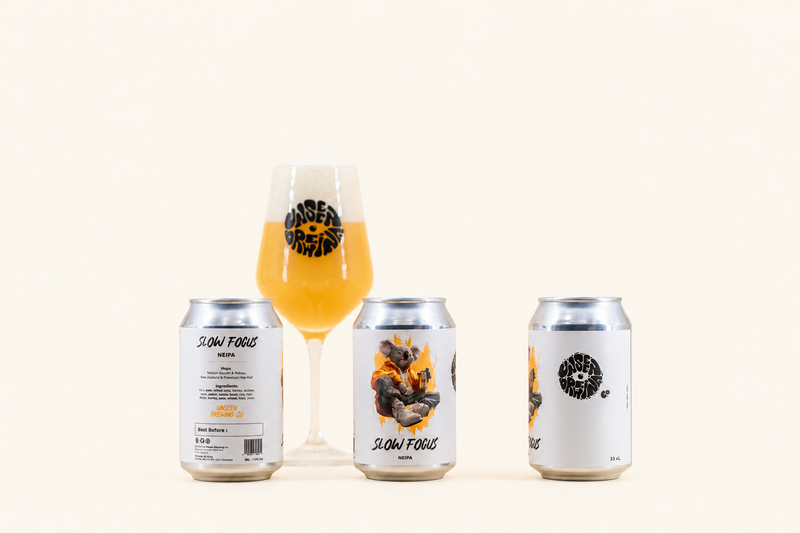
You stumbled on a hazy beer, golden like a sunset over Idaho, that smelled of mango and passion fruit from a metre away. The bartender told you "it's a NEIPA" with the air of someone who had just spoken a sacred word. And you went "oh yeah, of course" and nodded, before quietly checking on your phone what that actually meant.
We've been there too. That's why we wrote this guide.
NEIPA: the name first
NEIPA stands for New England India Pale Ale. Yes, it's long. Yes, brewers love acronyms. And yes, you can just say "NEIPA" and pass for someone who knows what they're talking about.
The "New England" part isn't there because the beer tastes like America, but because the style emerged in the New England region of the United States in the early 2010s. Breweries like The Alchemist (Vermont) popularised it with their legendary Heady Topper — a beer that literally changed people's idea of what an IPA could be.
It took a few years to reach Belgium and Europe. But when it did... let's just say we never looked back.
What makes a NEIPA different from a classic IPA
Because yes, a NEIPA and a classic IPA are the same family, but with completely different characters. A bit like two cousins: same DNA, opposite personalities.
The look: the "haze"
The first thing that strikes you is the appearance. A classic IPA is usually clear, amber, bright. A NEIPA, on the other hand, is hazy — sometimes downright opaque. That veil is what we call the haze.
The haze isn't a flaw, whatever old-school purists might think. It comes from suspended proteins, yeast and above all a particular hopping technique we'll get to in two seconds.
Hops: the star of the show
In a classic American IPA, hops are there for bitterness. In a NEIPA, they're there for aroma. It's a total paradigm shift.
NEIPA brewers make heavy use of a technique called dry hopping — adding hops cold, after fermentation, when the beer is no longer boiling. This preserves the hops' volatile aroma compounds, which would be lost to heat. The result: an explosion of tropical, floral, fruity aromas... without the aggressive bitterness of long-boiled hops.
The star hops of NEIPAs? Citra (mango, lime, tropical fruit), Mosaic (red berries, blueberry, earthiness), Galaxy (peach, passion fruit), or New Zealand hops like Nelson Sauvin (white grape, gooseberry) and Motueka (lemon, lime). At Unseen BC, we have a real passion for Kiwi hops — if you've already had our Slow Focus or our Nexus, you know why.
Yeast: the quiet accomplice
Yeast also plays a key role in the NEIPA style. The strains used produce fruity esters that boost the aroma profile, and often leave a round, soft, almost silky texture on the palate. Proteins from oats and wheat — added in large quantities to NEIPAs — contribute to that signature creamy body.
Bitterness: present but discreet
This might be the real magic trick. A NEIPA can contain as many hops as a very bitter West Coast IPA, but thanks to late dry hopping and the choice of varieties, the perceived bitterness is much softer. We call it a "juicy" beer, where the classic West Coast IPA was "bitter".
That's why newcomers love NEIPAs. And that's why craft beer lovers keep coming back to them.
The variants worth knowing
The NEIPA family has grown since its early days in Vermont. Here are the most common variations:
Session NEIPA — Same aroma profile, but with lower alcohol (usually under 4.5%). Ideal for a long tasting session without ending up under the table.
Double NEIPA (or DNEIPA) — More malt, more hops, more alcohol (usually between 7.5% and 8.5%). The volume gets turned up a notch in every sense. Our Frozen Rage at 8.2% and our Cosmic Art at 8% fall into this category.

Triple NEIPA — Extreme territory. ABVs brushing 11-12%, astronomical dry hops. To be enjoyed with respect (and with food).
Milkshake IPA — A variant that adds lactose (a non-fermentable sugar from milk) for an even creamier texture and extra sweetness. The name is spot on.
How to enjoy a NEIPA properly
NEIPAs are living beers. They evolve quickly and deserve a minimum of care.
Freshness is everything. Unlike some wines or top-fermented beers that improve with age, a NEIPA should be drunk as fresh as possible. The hops behind those tropical aromas oxidise quickly. A 6-month-old NEIPA will be far less interesting than a 3-week-old one. Always check the brew date or the best-before date.
Temperature. Between 6°C and 10°C. Too cold and the aromas close up. Too warm and the alcohol takes over. The sweet spot is a glass that's lightly "sweating".
The glass. A tulip glass or a wide IPA glass helps concentrate the aromas on the nose. Avoid straight pint glasses — they don't do the hops justice.
The first sniff. Before drinking, take the time to smell it. That's where the magic happens first. If your NEIPA smells of cardboard or wet paper, it has oxidised — too bad.
NEIPAs at Unseen BC: our vision
At Unseen BC, we've been brewing NEIPAs since day one. That's no accident: it's the style that made us fall in love with craft beer. Those juicy, generous beers that aren't afraid of flavour — that's exactly what we wanted to create, right from our first batches in a garage in Assesse.
Our NEIPA philosophy comes down to a few principles:
We don't skimp on hops. When we talk about 20 g/L of dry hop like in our Tane Mahuta, or 25 g/L like in our Pas l'temps de niaiser, it's not bragging — it's because we want every sip to be an aromatic slap in the face (the good kind of slap).
We explore New Zealand hops. Nelson Sauvin, Motueka, Riwaka, Wai-iti — these hops have a finesse and complexity you won't find anywhere else. They've become our signature.
We work on texture as much as aroma. A NEIPA without a creamy body is like a pizza without cheese. We add oats, sometimes wheat, to get that velvety feel that carries the aromas across the palate.
In a nutshell
A NEIPA is a new-generation IPA: hazy, juicy, aromatic, low in bitterness. It's the style that proved craft beer could be complex and approachable, demanding and generous, all at once.
It's also, let's be honest, the main reason two physiotherapists from Assesse decided to become brewers.
If you haven't tried one yet, our full range is there for that. And if you're already a fan, you know where to find us.
Want to taste our latest?
The angry Double NEIPA: Frozen Rage
Nexus, the Citra × Nelson Sauvin NEIPA
FAQ
What's the difference between a NEIPA and a West Coast IPA?
A NEIPA is hazy, juicy and low in bitterness; a West Coast IPA is clear, dry and assertively bitter. Both use lots of hops, but the NEIPA concentrates them in late dry hopping for aroma, while the West Coast IPA embraces bitterness. Same family, opposite characters: one wraps around you, the other cuts through.
Why is a NEIPA hazy?
The haze comes from oat and wheat proteins, yeast in suspension and heavy cold hopping. It isn't a flaw: these elements contribute to the creamy body and juicy feel that define the style. A perfectly clear NEIPA would have lost part of what makes it recognisable.
Is a NEIPA bitter?
Not much. A NEIPA can contain as many hops as a very bitter IPA, but most of them go in late and cold, as dry hops: you extract the aromatic oils without extracting the bitterness. The result is a "juicy" rather than "bitter" beer — mango, citrus and tropical fruit up front, gentle bitterness in the background. That's why the style also wins over people who usually steer clear of classic IPAs.
Where can I buy an Unseen NEIPA?
On www.unseenbc.com and at our partner bars and beer shops in Belgium. Right now: Nexus (NEIPA 6.5%, Citra and Nelson Sauvin), Slow Focus (NEIPA 7%) and Frozen Rage (Double NEIPA 8.2%). Our NEIPAs are brewed in limited batches and meant to be drunk fresh: the range turns over fast.
Dive into the Unseen — Unseen BC, Brussels
Fancy a taste? Discover our beers of the moment or get our latest releases delivered to your door with the Big Box, our Belgian craft beer box.